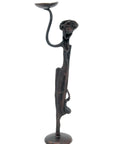
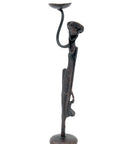
Abdoulaye Compaoré works at the intersection of the body and abstraction. His human figures are there, standing and recognisable, but something has made them lighter and more open. Their arms form curves that do not close. The torso becomes a void traversed by light. The head is a synthetic volume, topped by an added detail — a star, a bird or a ring — that appears to emerge from the body as a visible thought.
It is a radical choice. While other bronze sculptors seek the density of metal, Abdoulaye plays with emptiness. His sculptures breathe. They cast complex shadows that are an integral part of the work, whether on the wall or the floor, and these shadows shift with the light. A sculpture by Abdoulaye Compaoré never looks the same at 10 a.m. as it does in the late afternoon.
This is because Abdoulaye Compaoré does not seek to fix anything. He seeks to suggest. It is in this absence, this skilfully crafted void, that the essential emerges.